Pink Phoenix is Your Team

A Dragon Boat Team of Fierce Survivor Women

Your River

Pink Phoenix gets the best views on the Willamette .

Remembrance

We are all in each others hearts

Heart in Florence

Oh the places we have been.

2022 IBCPC Regatta New Zealand

Oh the places we will go.

Sunday, May 17, 2020

Week 5 - Playing the Long Game


   Playing the Long Game 

It has been said that playing the long game is just "showing up each day so you can do it again tomorrow." It requires consistency and discipline, an ability to never stop the process. This process must be created with a long term goal in mind. It is timely to be looking at our training as the process to get us to our physical peak for New Zealand. We have seen how focusing on off-season fitness and approaching water practices with intention has brought our crews better race times and performances. If you aren't planning for New Zealand your long game may be maintenance of or increasing strength for overall health. Playing the long game is rarely glamorous and often tedious. You can't cram in the long game. It takes consistency, patience and trust in the process. This process mindset will pay off by helping you grow in our sport and remain injury free.  


Using Workouts to Train for Racing

by Coach Anita


An ideal dragon boat race mapped out on a graph has a sharp increase in stroke rate (vertical Y axis) in a short amount of time (horizontal X axis) that rises to a peak and settles down to a rate that is sustained for the remainder of the race. This is true whether the distance is 200 meters or 2000 meters. Because of the difference in time between a 200 meter race and a 2000 meter race, the race pace must be adjusted in order to sustain it over the particular distance. In other words, a shorter race has a faster race pace than a longer race. A paddler’s ability to sustain any pace with intensity is dependent upon training.

All races have a start that involves rating up quickly, getting to what is known as the over rate (the peak on the graph), and then settling into race pace. In order to have a strong start, paddlers need to have a conditioned phosphagen energy system (aka immediate energy system, ATP-CP). This is accomplished by executing explosive power moves at the highest intensity for a brief to short amount of time (≤30 sec) followed by a rest and repeated numerous times. Maintaining a rate with intensity requires having a conditioned glycolytic energy system (aka short-term energy system, anaerobic lactate, lactic acid). Training the glycolytic energy system is achieved through high intensity efforts for a longer time period (≥45 sec to <3 min) followed by rest and repeated numerous times. Aerobic conditioning (aka long-term energy system, oxidative energy system) is developed through longer work periods (3+ min) performed at lower intensities, which make them sustainable. Conditioning all three systems is necessary in dragon boat racing. However, because we primarily race 250-500 meter races, our highest training need is in the immediate and short-term energy systems (phosphagen and glycolytic).

We have been given the luxury of time to prepare our bodies with off-the-water fitness activities as well as educate our brains about our sport and how it’s done. Conditioning can be accomplished with or without weights, through the workouts Coach Oden has been providing, by paddling, running, cycling and the like. Workouts like what Oden has been providing develop muscular strength while building stamina (the ability to maintain intensity) and endurance (the ability to keep going). Increased muscular strength enables us to generate more power. The key to having any workout be effective is to work hard. No amount of structuring and leading by someone else can accomplish that for you. When you’re working the immediate and short term energy systems it feels hard because of the high intensity required. However, the more you do it, the more adaptive your body becomes so you feel better able to perform them, and as a result, you are able to better perform what is required of you in the boat.

Even though we’re not on the water right now, take the long view and realize what you can be doing now in order to be prepared for when that time comes. Find a workout buddy to schedule time with, join Pat at her Zoom workout times, create or take a challenge to hold yourself accountable. And if you need a little encouragement, let us know. We’ll do what we can to support your efforts so long as you promise to work hard.


Flexibility By Coach Pat

Flexibility is the range of movement in a joint or a range of joints.  It also has to do with the ability of the muscle to lengthen across those joints.  The benefits of being flexible include improved mobility, posture, and increased range of motion which makes it easier to perform all exercises. Flexibility also reduces the risk of injury and muscle soreness. Overall flexibility diminishes with age and due to the demands of certain sports. 

As a paddler, keeping muscles loose is key to staying physically balanced and avoiding injury. Static stretching after a workout is not enough. As breast cancer survivors we have surgery and scar tissue issues. Reconstruction displaces muscle and that muscle has to relearn how to be engaged. Any type of flap reconstruction will require the remaining muscle to relearn how to engage and for the surrounding fascia to transmit that force. This takes time - up to a year. 

To increase muscle flexibility try using yoga and Pilates workouts. To increase joint flexibility, yoga is the winner. To strengthen after reconstruction, Pilates is your task master because pilates is will strengthen your core. You’ll notice that across different workouts many of the moves are the same.  

We have already introduced some flexibility work in this blog. We addressed these as rest and recovery.   


Consider adding an additional yoga workout for flexibility. This one is only 15 minutes long.

A Pilates workout like this one will add even more benefits.  Pilates for flexibility. 


We can't look for a spot stretching routine any more than a spot reducing diet. 

This warm up is something to aspire to specifically for paddling.  Have some fun with this one.  

Look for my email with a zoom call link to workout on Wednesday at 6 pm.   Also look for a morning workout email as well.  Try to do them both. 


Teamwork 

By Suzanne
This week I found a fun poem that was published in November 2013 in a blog from Eugephemisms. It made me think about all the support we give and get from each other both on and off the water and how we strive to stay in sync as athletes. I thought I would share it with you and hope you enjoy it as much as I did.


It's during training that I am the happiest.
It's when I can release stress and shout my heart out.
Where I can burp out loud and also laugh out loud.
It is where my teammates see me suffer.
They see me endure,
They see me fight.
It's where I get to motivate and receive motivation.
An opportunity to inspire, furthermore earn inspiration.
It keeps me focused as it gets intense.
Makes me admit my weaknesses; realize my strengths.
I sweat, I feel pain-I feel strong.
I perform, I work-I build.
I feel one with the team, I feel whole.
It is where I admire and get admired, too.
I teach, I learn, I get validated.
It is comforting, exciting and adrenaline-filled.
It prepares me as it pushes me to the limit.
At trainings I develop authentic self-discipline,
To be in sync with the team,
To be reminded to live in good trim.
It is during trainings that I execute my best,
Become as good as the rest.
For triumph and glee. For victory!
It is during trainings that I truly feel free.
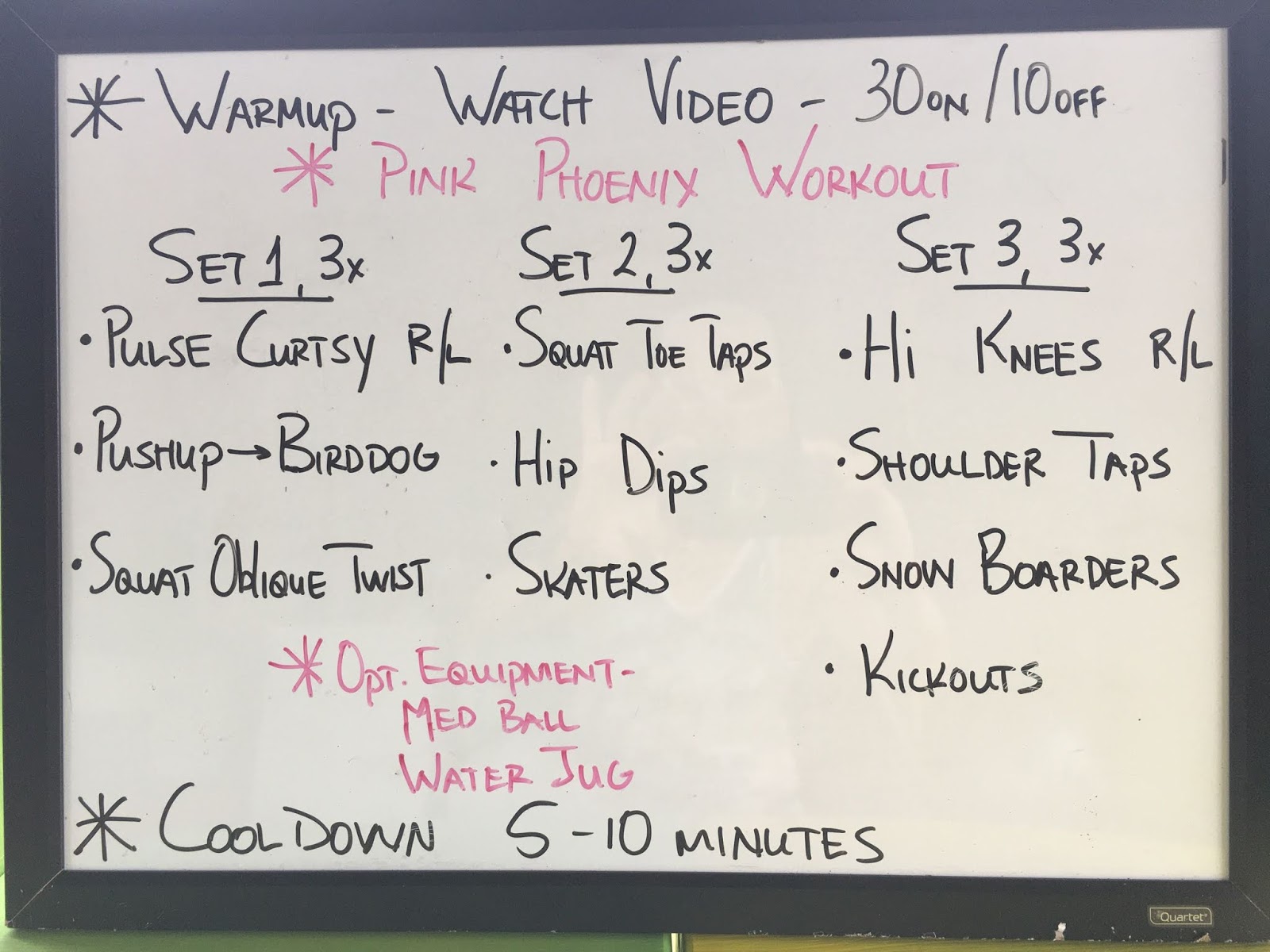


Week 5 Pinks Stay Strong Workout

With Coach Oden 


Fitness Challenge from Coach Oden

100 squats a day. 
Break it into whatever works for you.  10's, 20s, or all at once.
Post on the fitness tracker and everywhere.   Let's try to  get 700 squats this week or more.  Starts Monday!! Who is in ?  I know I am. 


Week 5 - Playing the Long Game


   Playing the Long Game 

It has been said that playing the long game is just "showing up each day so you can do it again tomorrow." It requires consistency and discipline, an ability to never stop the process. This process must be created with a long term goal in mind. It is timely to be looking at our training as the process to get us to our physical peak for New Zealand. We have seen how focusing on off-season fitness and approaching water practices with intention has brought our crews better race times and performances. If you aren't planning for New Zealand your long game may be maintenance of or increasing strength for overall health. Playing the long game is rarely glamorous and often tedious. You can't cram in the long game. It takes consistency, patience and trust in the process. This process mindset will pay off by helping you grow in our sport and remain injury free.  


Using Workouts to Train for Racing

by Coach Anita


An ideal dragon boat race mapped out on a graph has a sharp increase in stroke rate (vertical Y axis) in a short amount of time (horizontal X axis) that rises to a peak and settles down to a rate that is sustained for the remainder of the race. This is true whether the distance is 200 meters or 2000 meters. Because of the difference in time between a 200 meter race and a 2000 meter race, the race pace must be adjusted in order to sustain it over the particular distance. In other words, a shorter race has a faster race pace than a longer race. A paddler’s ability to sustain any pace with intensity is dependent upon training.

All races have a start that involves rating up quickly, getting to what is known as the over rate (the peak on the graph), and then settling into race pace. In order to have a strong start, paddlers need to have a conditioned phosphagen energy system (aka immediate energy system, ATP-CP). This is accomplished by executing explosive power moves at the highest intensity for a brief to short amount of time (≤30 sec) followed by a rest and repeated numerous times. Maintaining a rate with intensity requires having a conditioned glycolytic energy system (aka short-term energy system, anaerobic lactate, lactic acid). Training the glycolytic energy system is achieved through high intensity efforts for a longer time period (≥45 sec to <3 min) followed by rest and repeated numerous times. Aerobic conditioning (aka long-term energy system, oxidative energy system) is developed through longer work periods (3+ min) performed at lower intensities, which make them sustainable. Conditioning all three systems is necessary in dragon boat racing. However, because we primarily race 250-500 meter races, our highest training need is in the immediate and short-term energy systems (phosphagen and glycolytic).

We have been given the luxury of time to prepare our bodies with off-the-water fitness activities as well as educate our brains about our sport and how it’s done. Conditioning can be accomplished with or without weights, through the workouts Coach Oden has been providing, by paddling, running, cycling and the like. Workouts like what Oden has been providing develop muscular strength while building stamina (the ability to maintain intensity) and endurance (the ability to keep going). Increased muscular strength enables us to generate more power. The key to having any workout be effective is to work hard. No amount of structuring and leading by someone else can accomplish that for you. When you’re working the immediate and short term energy systems it feels hard because of the high intensity required. However, the more you do it, the more adaptive your body becomes so you feel better able to perform them, and as a result, you are able to better perform what is required of you in the boat.

Even though we’re not on the water right now, take the long view and realize what you can be doing now in order to be prepared for when that time comes. Find a workout buddy to schedule time with, join Pat at her Zoom workout times, create or take a challenge to hold yourself accountable. And if you need a little encouragement, let us know. We’ll do what we can to support your efforts so long as you promise to work hard.


Flexibility By Coach Pat

Flexibility is the range of movement in a joint or a range of joints.  It also has to do with the ability of the muscle to lengthen across those joints.  The benefits of being flexible include improved mobility, posture, and increased range of motion which makes it easier to perform all exercises. Flexibility also reduces the risk of injury and muscle soreness. Overall flexibility diminishes with age and due to the demands of certain sports. 

As a paddler, keeping muscles loose is key to staying physically balanced and avoiding injury. Static stretching after a workout is not enough. As breast cancer survivors we have surgery and scar tissue issues. Reconstruction displaces muscle and that muscle has to relearn how to be engaged. Any type of flap reconstruction will require the remaining muscle to relearn how to engage and for the surrounding fascia to transmit that force. This takes time - up to a year. 

To increase muscle flexibility try using yoga and Pilates workouts. To increase joint flexibility, yoga is the winner. To strengthen after reconstruction, Pilates is your task master because pilates is will strengthen your core. You’ll notice that across different workouts many of the moves are the same.  

We have already introduced some flexibility work in this blog. We addressed these as rest and recovery.   


Consider adding an additional yoga workout for flexibility. This one is only 15 minutes long.

A Pilates workout like this one will add even more benefits.  Pilates for flexibility. 


We can't look for a spot stretching routine any more than a spot reducing diet. 

This warm up is something to aspire to specifically for paddling.  Have some fun with this one.  

Look for my email with a zoom call link to workout on Wednesday at 6 pm.   Also look for a morning workout email as well.  Try to do them both. 


Teamwork 

By Suzanne
This week I found a fun poem that was published in November 2013 in a blog from Eugephemisms. It made me think about all the support we give and get from each other both on and off the water and how we strive to stay in sync as athletes. I thought I would share it with you and hope you enjoy it as much as I did.


It's during training that I am the happiest.
It's when I can release stress and shout my heart out.
Where I can burp out loud and also laugh out loud.
It is where my teammates see me suffer.
They see me endure,
They see me fight.
It's where I get to motivate and receive motivation.
An opportunity to inspire, furthermore earn inspiration.
It keeps me focused as it gets intense.
Makes me admit my weaknesses; realize my strengths.
I sweat, I feel pain-I feel strong.
I perform, I work-I build.
I feel one with the team, I feel whole.
It is where I admire and get admired, too.
I teach, I learn, I get validated.
It is comforting, exciting and adrenaline-filled.
It prepares me as it pushes me to the limit.
At trainings I develop authentic self-discipline,
To be in sync with the team,
To be reminded to live in good trim.
It is during trainings that I execute my best,
Become as good as the rest.
For triumph and glee. For victory!
It is during trainings that I truly feel free.


Week 5 Pinks Stay Strong Workout

With Coach Oden 


Fitness Challenge from Coach Oden

100 squats a day. 
Break it into whatever works for you.  10's, 20s, or all at once.
Post on the fitness tracker and everywhere.   Let's try to  get 700 squats this week or more.  Starts Monday!! Who is in ?  I know I am. 


Monday, May 11, 2020

Week 4 - No Shame

Week 4 - No Shame 


A big thank you to all who have taken the time to read this blog. A big shout out to the Fitness Tracker users and also to those of you who are utilizing the tools and workouts brought to you each week by TeamFitness. It makes putting together the blog a happy task for all of us.

We also know that for some adapting to this altered reality is hard and activities which were so important before are taking a back seat for many reasons. There is no shame in taking a break, most of us need some sort of break at times. Facing the reality that water practices will not be possible until late fall at best makes it all harder. (Although we can still hope to get on the water before the end of the year.) If you have been having difficulty getting motivated to participate in fitness activities start thinking about next steps. Your
 coaches are brainstorming fun ways to help us stay engaged during this off season.


Come Join Me for a Workout

By Coach Pat 

Sometimes having a training partner and an appointment is enough to help us over the hump.  How about many training partners?  I will be hosting group Zoom workouts each week, Starting with a warm up then into coach Oden's workout of the week. Put aside Wednesday evening at 6:00 pm. If we have enough interest I will add Monday mornings the following week. If you would like to lead one of the sessions even at a different time let me know so we can communicate and schedule.  What matters is we will do it together.  

 Functions of Different Training Methods

by Coach Anita

I’ve given you three articles covering the body’s energy systems, how they work, and how they are used in dragon boat paddling. This week I want to look at the different types of training methods and how we use them in practice to maximize our performance in races.

A broad definition of interval training is a period of work followed by a period of recovery, then repeated. You target different energy systems by adjusting the length of time and intensity level of the work period and the amount of recovery time.

Short, maximum intensity efforts with long recovery periods trains the phosphagen system (immediate energy system, ATP-CP). Slightly longer work periods with short rest periods train the glycolytic system (short-term energy, anaerobic lactate). Intervals of longer than 2 minutes train the oxidative system (long-term energy, aerobic).

In general, shorter and higher intensity intervals work the two anaerobic energy systems, and longer, lower intensity intervals target the aerobic energy system.

High intensity interval training (HIIT) involves short, intense bursts of 100% effort followed by a lower intense or full recovery effort. Individuals should be working at 85-100% of their maximum heart rate. Generally the work to recovery ratio is 2:1. HIIT workouts target anaerobic fitness but also improve aerobic power.

Tabata training is a specific type of HIIT that is traditionally structured with 20 seconds of maximum intensity work followed by 10 seconds of rest, performed 8 times. A tabata set takes 4 minutes to complete. The short rest period is not enough for full recovery which builds endurance.

Fartlek is a Swedish term that means “speed play.” It’s a training style that involves alternating moderate to hard efforts with easy efforts. Fartlek training is used to improve speed, stamina and endurance (and maybe regularity?).

Quick definition of terms because stamina and endurance are often interchanged but they are in fact different. Stamina refers to the muscles’ ability to perform at or near maximum capacity. So that’s your ability to maintain a particular level of intensity. Endurance is the maximum amount of time muscles can perform a certain action. So that’s the duration of time you can do something.

Workouts can be designed according to goals - improve overall speed, improve quick speed, build stamina, build endurance, build muscle, burn fat, lose weight. In our practices, we focus on three of these things: developing quick and overall speed, building stamina and increasing endurance.

For example, a 30/30 drill for power where you exert at 100% for 30 seconds, then actively recover at the same rate for 30 seconds, and repeat it 10 times, is designed to build stamina (maintaining intensity). Some drills can have myriad focuses. A power pyramid can be structured to primarily stress the phosphagen system (aka the immediate energy system) - 1-2-3-4-5-5-5-4-3-2-1 or focus on the glycolytic system (aka the short-term energy system) - 5-10-15-20-20-15-10-5. We often work multiple energy systems during a practice. A 3-minute paddle at 75% intensity works your long-term energy system (oxidative system), which might be done after a 30-second maximum effort with a 2-minute rest (repeated 4 times), which focuses on the immediate energy system (phosphagen system). The leap frog drill where a boat paddles to catch a boat further ahead, then backs down for a period until after the boat passes them, and then chases to pass it is an example of a Farlek workout that develops stamina, endurance and speed.

The sprint nature of dragon boat paddling requires specific training of the immediate energy system (phosphagen system) and the short-term energy system (glycolytic system). Through that training aerobic fitness is also developed. So while we’re off the water, consider the principles discussed here as well as what we do in practice and see how you can incorporate them into your workouts whether they are body weight training, plyometric moves, lifting, rope jumping, running, rowing, cycling, or walking.

It’s not lost on me that some of this information might be a little nerdy. So, I asked my dearest darling, aka my wife Rory, to read the above and give me some feedback. She asked to provide a layperson’s interpretation.


Rory’s interp:

Here’s what all this means: If you are out there doing “regular exercise” (walking 40 minutes, running 3 miles, biking 15-30 miles, treadmilling for 30 min, and ellipticalling for 60 minutes - meaning the show and resting at commercials) you are all badasses. BUT, basically this type of badassery isn’t going to prepare you for performance dragon boat racing. You need to incorporate the sh*t that’s HARD. Steady rate running, elliptical, walking are low intensity efforts. To be ready for dragon boat racing, you need to do shorter, higher intensity work to train your immediate and short term (aka anaerobic) energy systems. So get going on Oden’s workouts and look up YouTube HIIT, Fartlek, or Tabata workouts to get ready for New Zealand! Pink Phoenix is bringing home the gold!

If you haven’t met Rory, you can see she likes to K.I.S.S. (Keep It Simple Sally) and she loves Pink Phoenix.

If you have any questions or comments, please leave them in the comments section. I miss seeing you all with paddles in your hands!


Protein Bars vs. Protein Powders

By Suzanne (Health and Fitness)


Last week we talked about the importance of protein and the role of amino acids. Remember that amino acids are the building blocks of protein and are essential in the muscle-building and repair process. This week I wanted to provide you information on protein bars and powders. With all of the choices available it tends to get a bit confusing.

The best way to get your daily requirement of protein is through food. This may not always be possible especially following a workout when you may not feel like eating a meal. In comes the option of choosing bars and powders. Which type you choose depends on your goals and the quality of the product.

Here are some pros and cons of each type.

Bars
Pros:

  • chewing solid food can make you feel more satisfied than drinking your nutrition
  • protein in solid form suppresses hunger more readily than a liquefied protein meal (based on a 2011 study published in the Journal of Obesity)
  • in elderly, solid protein sources prove more satisfying than liquid forms (Hormone and Metabolic Research 2007)
  • convenient and ready on the spot, no refrigeration or water needed
  • tend to offer a better balance of macro-nutrients than powdered shakes
Cons:
  • can be high in sugar and artificial sweeteners
  • may be high in carbohydrates and fillers

Powders
Pros:

  • liquid forms are far superior when it comes to delivering amino acids into your blood stream (based on research)
  • testing done at 30 minutes and 4 hours following consumption showed higher levels of amino acids compared to bars
  • fastest way to get amino acids to muscles that have just finished working
Cons:
  • not always convenient
  • less fiber which can leave you less satisfied
  • may contain high levels of sugar or artificial sweeteners
  • may contain preservatives and chemicals
Each may be appropriate depending on your goals and situation. Research does suggest that liquid forms are superior to solid forms of proteins when it comes to delivering amino acids to your blood stream.

Advice from a dietitian is this: if you are deciding between a packaged bar or a homemade shake, you are better off with a blended mix of unsweetened fruit, milk, and pure protein powder than a store bought bar. Homemade bars made with pure protein powder, whole grains, nut butter, dried fruit can easily be high quality as a homemade protein shake.

I hope this information will help you make informed choices.


Work in Balance 

Beginning Single Leg Dead-lift 
By Coach Pat 

Balance is the body's ability to remain stable while standing, sitting or moving about. Balance declines with age, and can start to decline as early as 25 years of age, although 35 is more common. We know we aren’t 35 anymore, and for most of us our cancer journey included chemotherapy which also can have negative and lasting effects on our ability to balance. The good news is it's never too late to improve our balance.

Core strength is essential for balance. Strengthening your core muscles — in your abdomen, back, and hips — can help. "Core strength is intimately related to balance, because you need good stability at your core to have safe and effective movement at the hip, knee, and ankle," says Kailin Collins, a physical therapist at Harvard-affiliated Massachusetts General Hospital.

In addition to stabilizing your balance, a strong core improves your posture, reduces stress and lower back pain. Strengthening usually includes exercises such as planks, sit-ups, push-ups, and crunches. This all can sound pretty daunting.

Let's take a look at the exercises we already do with our workouts that are helping our balance.

  • Ankle rolls on one leg
  • Hip Rotations on one leg
  • Bird Dog
  • Plank
  • Side Plank
  • Sit Ups
  • Curtsy Lunges
  • Crossover Lunges
  • Lunges, all types
  • Single Leg Dead-lifts or Dippers
  • Supermans
  • Push-ups
  • Hip Raises

This is a general list as there are many variations of some of these exercises. All of them have modifications. A plank can be done against a table, on your knees or in the full plank position. How about that single leg dead-lift? Start with no weight, and if you have tight hips reduce the range of motion.

In all cases it is better to modify the exercise using good form, then when the modification is easy go to the next level.

Curtsy Lunge


Plank against a table
Bird Dog
Hip Bridge (Raise) 


Modified Side Plank


Week 4 Workout 
With Coach Oden


Week 4 - No Shame

Week 4 - No Shame 


A big thank you to all who have taken the time to read this blog. A big shout out to the Fitness Tracker users and also to those of you who are utilizing the tools and workouts brought to you each week by TeamFitness. It makes putting together the blog a happy task for all of us.

We also know that for some adapting to this altered reality is hard and activities which were so important before are taking a back seat for many reasons. There is no shame in taking a break, most of us need some sort of break at times. Facing the reality that water practices will not be possible until late fall at best makes it all harder. (Although we can still hope to get on the water before the end of the year.) If you have been having difficulty getting motivated to participate in fitness activities start thinking about next steps. Your
 coaches are brainstorming fun ways to help us stay engaged during this off season.


Come Join Me for a Workout

By Coach Pat 

Sometimes having a training partner and an appointment is enough to help us over the hump.  How about many training partners?  I will be hosting group Zoom workouts each week, Starting with a warm up then into coach Oden's workout of the week. Put aside Wednesday evening at 6:00 pm. If we have enough interest I will add Monday mornings the following week. If you would like to lead one of the sessions even at a different time let me know so we can communicate and schedule.  What matters is we will do it together.  

 Functions of Different Training Methods

by Coach Anita

I’ve given you three articles covering the body’s energy systems, how they work, and how they are used in dragon boat paddling. This week I want to look at the different types of training methods and how we use them in practice to maximize our performance in races.

A broad definition of interval training is a period of work followed by a period of recovery, then repeated. You target different energy systems by adjusting the length of time and intensity level of the work period and the amount of recovery time.

Short, maximum intensity efforts with long recovery periods trains the phosphagen system (immediate energy system, ATP-CP). Slightly longer work periods with short rest periods train the glycolytic system (short-term energy, anaerobic lactate). Intervals of longer than 2 minutes train the oxidative system (long-term energy, aerobic).

In general, shorter and higher intensity intervals work the two anaerobic energy systems, and longer, lower intensity intervals target the aerobic energy system.

High intensity interval training (HIIT) involves short, intense bursts of 100% effort followed by a lower intense or full recovery effort. Individuals should be working at 85-100% of their maximum heart rate. Generally the work to recovery ratio is 2:1. HIIT workouts target anaerobic fitness but also improve aerobic power.

Tabata training is a specific type of HIIT that is traditionally structured with 20 seconds of maximum intensity work followed by 10 seconds of rest, performed 8 times. A tabata set takes 4 minutes to complete. The short rest period is not enough for full recovery which builds endurance.

Fartlek is a Swedish term that means “speed play.” It’s a training style that involves alternating moderate to hard efforts with easy efforts. Fartlek training is used to improve speed, stamina and endurance (and maybe regularity?).

Quick definition of terms because stamina and endurance are often interchanged but they are in fact different. Stamina refers to the muscles’ ability to perform at or near maximum capacity. So that’s your ability to maintain a particular level of intensity. Endurance is the maximum amount of time muscles can perform a certain action. So that’s the duration of time you can do something.

Workouts can be designed according to goals - improve overall speed, improve quick speed, build stamina, build endurance, build muscle, burn fat, lose weight. In our practices, we focus on three of these things: developing quick and overall speed, building stamina and increasing endurance.

For example, a 30/30 drill for power where you exert at 100% for 30 seconds, then actively recover at the same rate for 30 seconds, and repeat it 10 times, is designed to build stamina (maintaining intensity). Some drills can have myriad focuses. A power pyramid can be structured to primarily stress the phosphagen system (aka the immediate energy system) - 1-2-3-4-5-5-5-4-3-2-1 or focus on the glycolytic system (aka the short-term energy system) - 5-10-15-20-20-15-10-5. We often work multiple energy systems during a practice. A 3-minute paddle at 75% intensity works your long-term energy system (oxidative system), which might be done after a 30-second maximum effort with a 2-minute rest (repeated 4 times), which focuses on the immediate energy system (phosphagen system). The leap frog drill where a boat paddles to catch a boat further ahead, then backs down for a period until after the boat passes them, and then chases to pass it is an example of a Farlek workout that develops stamina, endurance and speed.

The sprint nature of dragon boat paddling requires specific training of the immediate energy system (phosphagen system) and the short-term energy system (glycolytic system). Through that training aerobic fitness is also developed. So while we’re off the water, consider the principles discussed here as well as what we do in practice and see how you can incorporate them into your workouts whether they are body weight training, plyometric moves, lifting, rope jumping, running, rowing, cycling, or walking.

It’s not lost on me that some of this information might be a little nerdy. So, I asked my dearest darling, aka my wife Rory, to read the above and give me some feedback. She asked to provide a layperson’s interpretation.


Rory’s interp:

Here’s what all this means: If you are out there doing “regular exercise” (walking 40 minutes, running 3 miles, biking 15-30 miles, treadmilling for 30 min, and ellipticalling for 60 minutes - meaning the show and resting at commercials) you are all badasses. BUT, basically this type of badassery isn’t going to prepare you for performance dragon boat racing. You need to incorporate the sh*t that’s HARD. Steady rate running, elliptical, walking are low intensity efforts. To be ready for dragon boat racing, you need to do shorter, higher intensity work to train your immediate and short term (aka anaerobic) energy systems. So get going on Oden’s workouts and look up YouTube HIIT, Fartlek, or Tabata workouts to get ready for New Zealand! Pink Phoenix is bringing home the gold!

If you haven’t met Rory, you can see she likes to K.I.S.S. (Keep It Simple Sally) and she loves Pink Phoenix.

If you have any questions or comments, please leave them in the comments section. I miss seeing you all with paddles in your hands!


Protein Bars vs. Protein Powders

By Suzanne (Health and Fitness)


Last week we talked about the importance of protein and the role of amino acids. Remember that amino acids are the building blocks of protein and are essential in the muscle-building and repair process. This week I wanted to provide you information on protein bars and powders. With all of the choices available it tends to get a bit confusing.

The best way to get your daily requirement of protein is through food. This may not always be possible especially following a workout when you may not feel like eating a meal. In comes the option of choosing bars and powders. Which type you choose depends on your goals and the quality of the product.

Here are some pros and cons of each type.

Bars
Pros:

  • chewing solid food can make you feel more satisfied than drinking your nutrition
  • protein in solid form suppresses hunger more readily than a liquefied protein meal (based on a 2011 study published in the Journal of Obesity)
  • in elderly, solid protein sources prove more satisfying than liquid forms (Hormone and Metabolic Research 2007)
  • convenient and ready on the spot, no refrigeration or water needed
  • tend to offer a better balance of macro-nutrients than powdered shakes
Cons:
  • can be high in sugar and artificial sweeteners
  • may be high in carbohydrates and fillers

Powders
Pros:

  • liquid forms are far superior when it comes to delivering amino acids into your blood stream (based on research)
  • testing done at 30 minutes and 4 hours following consumption showed higher levels of amino acids compared to bars
  • fastest way to get amino acids to muscles that have just finished working
Cons:
  • not always convenient
  • less fiber which can leave you less satisfied
  • may contain high levels of sugar or artificial sweeteners
  • may contain preservatives and chemicals
Each may be appropriate depending on your goals and situation. Research does suggest that liquid forms are superior to solid forms of proteins when it comes to delivering amino acids to your blood stream.

Advice from a dietitian is this: if you are deciding between a packaged bar or a homemade shake, you are better off with a blended mix of unsweetened fruit, milk, and pure protein powder than a store bought bar. Homemade bars made with pure protein powder, whole grains, nut butter, dried fruit can easily be high quality as a homemade protein shake.

I hope this information will help you make informed choices.


Work in Balance 

Beginning Single Leg Dead-lift 
By Coach Pat 

Balance is the body's ability to remain stable while standing, sitting or moving about. Balance declines with age, and can start to decline as early as 25 years of age, although 35 is more common. We know we aren’t 35 anymore, and for most of us our cancer journey included chemotherapy which also can have negative and lasting effects on our ability to balance. The good news is it's never too late to improve our balance.

Core strength is essential for balance. Strengthening your core muscles — in your abdomen, back, and hips — can help. "Core strength is intimately related to balance, because you need good stability at your core to have safe and effective movement at the hip, knee, and ankle," says Kailin Collins, a physical therapist at Harvard-affiliated Massachusetts General Hospital.

In addition to stabilizing your balance, a strong core improves your posture, reduces stress and lower back pain. Strengthening usually includes exercises such as planks, sit-ups, push-ups, and crunches. This all can sound pretty daunting.

Let's take a look at the exercises we already do with our workouts that are helping our balance.

  • Ankle rolls on one leg
  • Hip Rotations on one leg
  • Bird Dog
  • Plank
  • Side Plank
  • Sit Ups
  • Curtsy Lunges
  • Crossover Lunges
  • Lunges, all types
  • Single Leg Dead-lifts or Dippers
  • Supermans
  • Push-ups
  • Hip Raises

This is a general list as there are many variations of some of these exercises. All of them have modifications. A plank can be done against a table, on your knees or in the full plank position. How about that single leg dead-lift? Start with no weight, and if you have tight hips reduce the range of motion.

In all cases it is better to modify the exercise using good form, then when the modification is easy go to the next level.

Curtsy Lunge


Plank against a table
Bird Dog
Hip Bridge (Raise) 


Modified Side Plank


Week 4 Workout 
With Coach Oden


Twitter Delicious Facebook Digg Stumbleupon Favorites More