Pink Phoenix is Your Team

A Dragon Boat Team of Fierce Survivor Women

Your River

Pink Phoenix gets the best views on the Willamette .

Remembrance

We are all in each others hearts

Heart in Florence

Oh the places we have been.

2022 IBCPC Regatta New Zealand

Oh the places we will go.

Monday, August 24, 2020

Week Nineteen - Mixing it Up


The Importance of Intensity

by Coach Anita

Whether we’re on the water or not, it is important to be doing conditioning that involves intensity. Think about a dragon boat race. Is there any part of it that does not involve intensity? The adage you need to practice how you want to perform is the same with conditioning and exercise. If you are training to participate in the Stroll Olympics then long gentle walks are appropriate training. Dragon boat racing is not a long, gentle walk.


I’ve discussed the body’s three types of energy systems several times. Just like the muscles in our bodies, our energy systems require training and conditioning to get them into shape and to maintain that development. If you’d been training for three months to run a 10K and after the event didn’t run or do similarly cardio intense activities for three months, during your next run you would likely feel more fatigued than you had felt in your training period before the event. Essentially you would have lost some of the conditioning you had achieved. We often see this during the off-the-water season, and once the on-water season starts again, there is some ground to make up. However, it doesn’t have to be like that. Once a level of conditioning is achieved, it does not take as much work to maintain that level as it did to achieve it. Athletes who look to continually improve rarely settle into a maintenance mode (even though there are benefits to taking training breaks in order to break development plateaus - that’s a whole other article).


This is why I want you to include intensity work as part of your exercise activities. If you want to ensure your return to dragon boat practice is not a remedial experience, it is necessary that your activities mimic the cardiovascular and strength work we do on the boat. There should be short maximum efforts with short breaks performed repeatedly. There should be longer efforts that are sustained at a high level of work. There should be sustained lower level efforts done for even longer periods of time. These are the basic training methodology for the body’s three energy systems. You don’t have to do separate sessions for each type, nor do you have to focus on each system equally. Think of your training like a pyramid divided into three levels with the width of it representing training time needed. The base of the pyramid is endurance (the oxidative or aerobic energy system). The training sessions for endurance are done at low intensity and take the longest amount of time. The next level up is for race pace training (the glycolic or short-term energy system). Because the effort has to be harder, the time spent performing the efforts is shorter than endurance training. The top third of the pyramid is sprint training (the ATP-CP or immediate energy system). This type of training requires your maximum effort possible and therefore has the shortest duration of effort. 


You can structure workouts to include work at the top of the pyramid (e.g. 30 seconds maximum effort, 30 seconds off or lowest intensity, repeated 5-10 times; one minute break; repeat entire sequence 3-5 times) and then transition to the work at the bottom of the pyramid (e.g. 5-10 minutes of low intensity effort, 1 minute break; repeat sequence 2-3 times). A workout could include work in the middle of the pyramid (e.g. 1-1; 2-1; 3-1; 3-1; 2-1; 1-1 - 1 minute high intensity, 1 minute off; 2 minutes high intensity, 1 minute off; 3 minutes high intensity, etc. repeated 3 times) and then transition to the bottom of the pyramid for lower intensity work for the remaining period of your workout.  


Keep training with your eye on the prize - racing in a Pink Phoenix dragon boat.


Coach Oden's Corner

Out of ideas ?

If you’ve run out of ideas. If you’re having a hard time being creative. Here’s a way to get your workout in with some regular household items. 

In lieu of using weights: 

  • 1-gallon water jug = 8 pounds

  • 1 Can of coconut milk = 1 pound

  • 1 bottle of wine = 2 pounds

  • Backpack with books = Random – you decide

  • Sandbags – be creative and make your own

  • Fill your purse up

  • Fill up a suitcase

  • Laundry Detergent Jugs

  • Old tires to toss around or jump in and out of or do push-ups and dips off of

  • Anything from Costco!

  • Liquor bottles – especially the half gallons (not saying you have them, but if you do!)

  • A toolbox from the garage

Here’s some ideas for doing overhead squats: 

  • Use a jump rope or a PVC pipe

  • Grab your dragon boat paddle

  • Hold it overhead and squat down with it

Find something to step up on and do pushups and dips from:

  • A step stool

  • Steps to your deck

  • A bench outside

  • Make a box

  • A picnic table

  • A chair that doesn’t have wheels

If you want to get more creative, do your workout someplace new:  

  • Set up a designated area in your garage

  • Go to a playground, or a schoolyard, or a park

  • There are monkey bars, swing sets, ropes to climb, stairs to go up

  • Go to Mt. Tabor and run or walk the stairs

  • Visit your local track and do lunges for a lap, run a lap, walk a lap, skip a lap

Most of all, keep it simple (KISS). You know yourself better than anyone. So designate a time that’s going to work for you, and stick with it. Use what you have at your disposal. This is just a sample of what we all have at home to use. If you don’t know how to create a workout for yourself, use the format I’ve been using on the videos: 

  • 3 sets of 3 exercises, 3 rounds each, 30 seconds on, 10 seconds off. Download the HITT app. 

  • Do 1 lower body exercise, 1 upper body exercise, 1 core exercise in each set. And for a bonus, add some plyo. Plyo keeps us balanced, quick and reactive. 

Sample Workout: 


Set 1: 

Squats

Pushups

Crunches

Set 2: 

Backward lunges

Tricep dips

Bicycles

Set 3: 

Step-ups

Bicep curls

Russian twists

Don’t do the same thing every day. Try to get some form of movement in every day. Movement keeps your joints healthy, stiffness and soreness at bay, and decreases fatigue. It improves your overall health, body and mind. 
Download this Free Vector | Card suits setWorkout Mix Ups

with Coach Pat


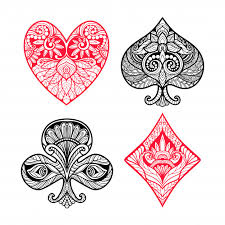
We have been enjoying Coach Oden's workouts now for awhile. It must be time to mix it up a bit. One workout I enjoy is a "Deck of Cards" workout. Basing the workout on your fitness goals and the equipment you have available you can get very creative designing these workouts. You can do 4 exercises, 8 exercises or any combination, red cards, black cards you name it. There are so many ways to put one of these together and we will be exploring a few in the next weeks. My go to format is one with eight exercises. Each suit is an exercise, the face value of the card is how many reps you do. Each face card has it's own exercise and number of reps associated.

Unlike our fixed exercise sets, what exercise comes next is a surprise. Go from each exercise to the next without delay.

This weeks workout :

Diamonds: Upper Body - Windmill push ups Clubs: Lower Body - Backward lunges (alternating - one rep equals 1x each side) Hearts: Core - V-ups Spades: Balance : Single leg dead lifts

Jacks: 10 squat jumps Queens: 15 Jumping Jacks Kings: 20 skaters Aces: 30 Mountain climbers

You can modify to lower or increase intensity on any exercise. Keep in mind that doing an exercise in good form is more important than the level of difficulty. See you Wednesday.


Monday, August 17, 2020

Week 18 - Lightning Strikes

Creating a Challenge 

By Coach Anita

We hear the terms “active” and “exercise” often used synonymously when it comes to movement. While all movement is active and essential to overall health and fitness, not all levels of activity are in the category of exercise. A simple definition of exercise is activity requiring physical effort, carried out to sustain or improve health and fitness. Exercise can be cardiovascularly focused or can focus on muscle strengthening. 


So I want to provide some ideas on how to incorporate exercise into your activities. 


WALKING

Hands down, walking is one of the easiest and best things we can do to stay active and get exercise. When walking at a leisurely pace, you are not elevating your heart rate so a longer duration provides you the most benefit. When walking at a brisk pace, the duration can be shorter. But what will really add a little boost to your routine is variety. The body gets acclimated to behaviors and movement so it’s important to incorporate new challenges. If you regularly walk at a brisk pace, consider adding some hill climbing and/or stair climbing. If those are already part of the routine, seek out different routes with these features and/or repeating the efforts multiple times. If you prefer a leisurely pace, strive for a minimum of 60 continuous minutes. Enhance the effort by carrying a backpack weighted with books or carrying hand weights. You can add sets of arm curls, walking lunges, or shoulder presses for muscle strengthening. Adding in bursts of speed from one landmark to another adds a cardiovascular boost to a leisurely walk. Set a goal (5-10 intervals) and see how you feel. Play with the type of options you add and the frequency in which they are incorporated.


RUNNING

Running is a cardiovascularly focused activity. A gentle pace over a long duration focuses on the oxidative energy system (aka aerobic system, long-term energy system). Being able to comfortably carry on a conversation while running is a sign of a long, slow, duration/distance (LSD) run. This type of training is important for developing endurance. Picking up the pace, running for a shorter amount of time, and not being able to say more than a few words at a time trains the glycolytic energy system (aka short-term energy system). Varying the type of running you do keeps your body from plateauing, in terms of training. Hills and stairs are great tools for adding variety to a run, and repeating them at various intervals helps develop stamina in your short-term energy system. Adding in Fartlek work (“speed play”) where you incorporate speed intervals with endurance training is also a great way to enhance a regular running routine. (The link provides a basic Fartlek workout.)  


CYCLING

Outdoor cycling is more gentle on the body than running and also provides great cardiovascular training. Just like with walking and running, the exertion level determines how long you need to do it for the most benefit. A gentle pace where it’s easy to hold a conversation requires a longer duration to receive the most benefit. Riding with sustained effort will yield benefits with a shorter duration. Hills are a natural tool for training. Whether you’re taking a hill at a constant, deliberate pace or sprinting and exerting hard to get to the top, the increased resistance offered by hills always provides a benefit (constant pace builds endurance, sprinting builds stamina). Try tackling a moderate size hill with a hard push to the top, enjoy the descent down and then go back up with a constant deliberate pace. Fartlek workouts are fun and effective on a bicycle, too.


PADDLING

Whether you’re paddling a canoe, an SUP, or a kayak you can work your immediate energy system, short-term energy system and long-term energy system. As I’ve said before, all three are used in dragon boat racing. If you experience muscle soreness after a new type of paddling, that indicates muscle strengthening. You might be using muscles differently than in a dragon boat. If you’ve been getting out on a human-powered watercraft and would like to incorporate a workout into your outing, warm up and do a series of 30-30 sprints (30 seconds at highest intensity, 30 seconds leisurely paddle). If you don’t have a timing mechanism, do 45 strokes. Your series can start at 5 or 10, depending upon your fitness level, and for 3-5 sets. Rest for a minute between sets. Then continue your regular paddle. During another paddle you can try a time pyramid. Paddle for one minute as hard as you can, then leisurely paddle for one minute. Then paddle for 3 minutes as hard as you can, 3 minute leisurely. 5 minutes as hard as you can, 5 minutes leisurely. Work back down the pyramid. (You can make the leisurely paddle a little more intense to increase the difficulty.) That’s a 36 minute pyramid workout. Then continue your normal paddle. If you want to simply ratchet up a regular paddle outing, try beating the time it normally takes you from push off to return. Or striving to see how far you can get before you have to turn back for a time-constrained paddle. 


Anything you enjoy doing is ideal to use for exercise. Using a portion of your allotted time or designating an entire session for exercise will enhance your fitness training. Varying the intensities and types of work you do as well as the frequency are easy ways to keep your exercise efforts fun and beneficial.


The Importance of Stretching

By Suzanne Frank


Stretching is important prior to and following any type of physical activity or sporting events. Stretching loosens muscles, allows for better movement and reduces the risk of injury.There are two types of stretches-dynamic and static.

Dynamic stretches involve slow controlled movements. These stretches should be specific to the muscles you plan to use. For example, do arm swings to stretch and loosen your arm muscles before an upper body weight training session.

Static stretches provide a slow cool down period and are held for 15-30 seconds at a time. This type of stretching helps to reduce soreness. An example of a static shoulder stretch would involve standing straight with your feet a bit wider than shoulder width apart and your knees slightly bent. Position your left arm across your chest so that it is parallel with the floor. Place your right hand under the left elbow and move the arm closer to your chest until you feel your shoulder stretch. Hold for 15-30 seconds. Repeat with the right arm.


Here are some common errors that people may make during stretching and how to fix the errors:

  • Holding your breath- it is not uncommon to hold your breath when you are stretching. This can cause our bodies to remain tense and and our muscles to remain contracted. To fix this inhale deeply before you start stretching and exhale as you gradually move into the stretch. Continue to breathe slowly as you feel your muscle stretch.
  • Stretching for too long- people may believe that the more stretching you do the better the result. this is not the case. To properly stretch a muscle group you should hold the stretch between 10 and 30 seconds. Each stretch should be done 2-6 reps per muscle.
  • Pushing a stretch too far- this can cause injury to the muscle or the surrounding joints or ligaments. Try not to stretch beyond what is comfortable.
  • Avoid stretching cold muscles- before stretching for any reason, warm-up for 5-10 minutes to prevent injury (example: a short walk while swinging your arms as a warm-up).
Finally, listen to your body and don't push a muscle too far. If it hurts STOP!

Pinks Stay Strong Workout Week 18

With Coach Oden 

This workout uses some weight.   Two full gallon water bottles are about 8 lb each.  If you have weights you can use those as well or do the exercises without additional weight. 

Just for Fun 

by Coach Pat 

I am excited about how many different ways Pinks are finding to stay on the water.  I know we have kayakers, SUP's, OC's, tradional canoes and maybe someone has a surf-ski.  I am right there as well trying my hand at OC.  

I love the water and I love paddling on just about any craft.  I find when I feel confident on a new craft my next thoughts go to how to improve my stroke so I can use my body more efficiently.  This helps move the craft faster and avoids injury.   

This week I tried hard to write something worthwhile, and for every 100 words I found myself wandering back to this subject of stroke, efficiency and type of craft.   The similarities in stroke,  the parts, and the differences.  Here are a few short YouTube videos that look at the components of each stroke.   You will feel right at home here, you already know the basics and have the strength to  adapt to a new craft.  Have fun!   


John Puakea Tahitian Outrigger Stroke : If you are SUP person you will want to watch this too. 

Bio-mechanics of Tahitian outrigger stroke


Kayak Tips:  

Flatwater kayaking for competition.   The sroke elements are so familiar

SUP getting more power in your stroke

Using your core with SUP stroke 


Monday, August 10, 2020

Week Seventeen - Way Beyond Compare


Improving Posture


By Suzanne Frank

Good posture is one thing I struggle with especially since having breast reconstruction. Prior to my surgeries when I became fatigued after a long day of meetings or working on the computer or having too much stress I found I was slouching/hunching my shoulders and even holding my shoulders up closer than I should to my ears. I was aware that I needed to work on fixing this. Much to my dismay my breast reconstruction left me with a much larger chest than my original size. My slumping/hunching worsened. I think this happened due to being self conscious and thinking that people would notice the new cleavage I was sporting (most people where I worked were unaware that I had breast cancer reconstruction). My body got used to being hunched over and I have been actively working on improving my posture. When I stood tall with my shoulders back and down and my hands at my sides it felt awkward and uncomfortable. This was going to be a challenge.

Here are some benefits of having good posture:

  • Improved balance- this not only lowers your risk of falls, it can also improve your athletic ability
  • Lower risk of injury- moving, standing, and sitting correctly reduces the strain on your muscles, joints and ligaments
  • Less back pain- good posture puts less stress and tension on the discs and vertebra in your spine
  • Fewer headaches- poor posture can put extra strain on your neck, which can lead to tension headaches
  • Improved breathing and circulation-when your vital organs are compressed by slouching, it can help your blood flow more easily through your blood vessels and organs.
 I have to check myself several times a day to do a posture check and make corrections.There are many exercises that will help strengthen muscles to help improve posture. You can find examples on the internet or YouTube.

Here are some tips:

  • Stand straight and tall with your shoulders relaxed and pulled back slightly.
  • Stand with your feet approximately shoulder width apart with your weight mostly on the balls of your feet
  • Keep your knees slightly bent
  • Keep your abdominal muscles tight
  • Keep your head level, not bent forward

I hope the information will help any of you that have challenges maintaining good posture.


Shake It Up


By Coach Anita


It is natural to get into behavioral habits. Once our bodies become accustomed to something or it doesn’t feel uncomfortable, we are likely to continue a behavior. This is especially true with exercise. Most of us have exercises we prefer to do versus something less comfortable or more taxing. Take a look at your exercise workouts and look for habits. Are there certain core exercises you always substitute out? Do you tend to favor more leg work than upper body? This generally means that the areas you favor are already strong, and the areas you avoid would benefit from more work.


This is true for cardiovascular exercise as well. The very first blog article I wrote was about the body’s different energy systems, and there was a link to cardio workouts for the different systems. Reflecting back on sixteen weeks, think about the types of cardio work you have been doing. Have you been doing work at 100% effort for brief periods of time, resting, and then repeating? If so, you’ve been training your ATP-CP system also referred to as the immediate energy system. This energy system is what we use in the first three explosive strokes of our start sequence. Have you been doing a little bit longer work at a high level (but not 100%), with brief rests and repeating? Oden’s workouts are structured this way. This type of training is benefiting your Anaerobic Lactate/Glycolic system, aka the short-term energy system. This energy system is what is active in high intensity work that lasts between 1-3 minutes. This energy system is predominant in a 500 meter dragon boat race. Maybe you’ve been focusing on training your Oxidative system (aka aerobic or long term energy system). This system is used for activities longer than 3 minutes, and is conducted at lower intensities than the others so that they can be performed for longer periods of time. Aerobic training can be done by walking, running, biking, paddling - just about anything where your heart rate increases - at an intensity level that can be sustained for a longer period of time. By training your aerobic system, you are developing endurance which also benefits your short-term energy system.


If you find that you haven’t been providing equal training time to the three energy systems, perhaps it’s time to diversify. If you do Oden’s workout once a week, maybe consider adding in a cardio focused workout by doing a long walk. Consider making it a combination workout by starting with an all-out sprint up a set of stairs or a hill, repeating it several times, and then do a longer walk at a lower intensity. This same behavior can be done in a kayak, on an SUP, a bicycle, rowing machine or with a jump rope.


The more diversity you have in your workouts the better your overall training. When you start to get bored with a workout or notice that the challenge isn’t as great, consider changing things up. It’s okay to take a break from focused workouts and just be active for the fun of it. After taking a break from your regular workouts you will likely feel reinvigorated and excited to begin again. If you don’t need a break but the thrill is gone, maybe set a small goal or two, and see if a little win here and there motivates you toward something else. I get energized when I read new research about the effects of exercise or find new exercises for a body part, and it helps me get excited to workout. There are many books and online resources for ideas.


It’s August 2020. No one could have predicted we’d be in the situation we are today, so use this shakeup in routine to shake up your routine. Share in the comments if you’ve found something to help reinvigorate your routine.

Week Seventeen Workout 
with Coach Oden


Sore and Very Sore


by Coach Pat

Last week I had the great fortune to be looking at the Ross island Bridge from the water. I was paddling but the bridge was staying the same size, it looked close but with current and head wind the last stretch was difficult. I was trying a new outrigger stroke , and to make distance going in and out of power sets. I work out and I have paddled a couple of other times this year. Every year when we get back to dragon boating there is a period of acclimation for our bodies, paddling is just different. But this was new and I got a real good reminder of what it feels like to start a new workout / sport.

Delayed onset muscle soreness (DOMS) usually sets in from 8 to 24 hours after an activity and peaks 48 - 72 hours after. The muscles which have been torn down start to heal and build up. Extreme soreness shouldn’t happen all the time, but when you push too hard at something new you can have serious pain. Time is your friend, but there are some other things you can do.

Get off the couch: no matter how sore you are you need to move. Get the blood flowing to your muscles. This should be a light workout, depending on how you feel your regular workout may not be the answer. At the Wednesday night workout , everyone heard how sore I was, but I powered through the workout and felt better for doing it.  On Thursday I managed a good walk and Friday was total rest.   How hard you work out has to be judged based on how and where you are sore. Don’t sit, but you may need to modify intensity and weight load.

Hydrate and then hydrate some more: It is generally believed that good hydration will help minimize soreness and that continuing to hydrate will assist your body in eliminating the toxins and waste products produced from breaking down muscle.


Stretch : Stretching and foam rolling may bring relief. Keep it light and avoid pain.

Eat Protein: Protein is essential for healing muscle. Try and grab a protein rich snack within an hour of exercise.

Ice and Heat: Icing will provide temporary relief by reducing inflammation. Heat, like a bath or hot tub can also provide some relief but is much more tricky as you can get adverse side effects. Try icing for 20 minutes each hour.

Keep your focus on your body. If the soreness hasn’t reduced or gone away in 72 hours you may have an injury. If you are experiencing sharp pain or had sharp pain during your workout this also could indicate injury and not just DOMS.

Week Seventeen - Way Beyond Compare


Improving Posture


By Suzanne Frank

Good posture is one thing I struggle with especially since having breast reconstruction. Prior to my surgeries when I became fatigued after a long day of meetings or working on the computer or having too much stress I found I was slouching/hunching my shoulders and even holding my shoulders up closer than I should to my ears. I was aware that I needed to work on fixing this. Much to my dismay my breast reconstruction left me with a much larger chest than my original size. My slumping/hunching worsened. I think this happened due to being self conscious and thinking that people would notice the new cleavage I was sporting (most people where I worked were unaware that I had breast cancer reconstruction). My body got used to being hunched over and I have been actively working on improving my posture. When I stood tall with my shoulders back and down and my hands at my sides it felt awkward and uncomfortable. This was going to be a challenge.

Here are some benefits of having good posture:

  • Improved balance- this not only lowers your risk of falls, it can also improve your athletic ability
  • Lower risk of injury- moving, standing, and sitting correctly reduces the strain on your muscles, joints and ligaments
  • Less back pain- good posture puts less stress and tension on the discs and vertebra in your spine
  • Fewer headaches- poor posture can put extra strain on your neck, which can lead to tension headaches
  • Improved breathing and circulation-when your vital organs are compressed by slouching, it can help your blood flow more easily through your blood vessels and organs.
 I have to check myself several times a day to do a posture check and make corrections.There are many exercises that will help strengthen muscles to help improve posture. You can find examples on the internet or YouTube.

Here are some tips:

  • Stand straight and tall with your shoulders relaxed and pulled back slightly.
  • Stand with your feet approximately shoulder width apart with your weight mostly on the balls of your feet
  • Keep your knees slightly bent
  • Keep your abdominal muscles tight
  • Keep your head level, not bent forward

I hope the information will help any of you that have challenges maintaining good posture.


Shake It Up


By Coach Anita


It is natural to get into behavioral habits. Once our bodies become accustomed to something or it doesn’t feel uncomfortable, we are likely to continue a behavior. This is especially true with exercise. Most of us have exercises we prefer to do versus something less comfortable or more taxing. Take a look at your exercise workouts and look for habits. Are there certain core exercises you always substitute out? Do you tend to favor more leg work than upper body? This generally means that the areas you favor are already strong, and the areas you avoid would benefit from more work.


This is true for cardiovascular exercise as well. The very first blog article I wrote was about the body’s different energy systems, and there was a link to cardio workouts for the different systems. Reflecting back on sixteen weeks, think about the types of cardio work you have been doing. Have you been doing work at 100% effort for brief periods of time, resting, and then repeating? If so, you’ve been training your ATP-CP system also referred to as the immediate energy system. This energy system is what we use in the first three explosive strokes of our start sequence. Have you been doing a little bit longer work at a high level (but not 100%), with brief rests and repeating? Oden’s workouts are structured this way. This type of training is benefiting your Anaerobic Lactate/Glycolic system, aka the short-term energy system. This energy system is what is active in high intensity work that lasts between 1-3 minutes. This energy system is predominant in a 500 meter dragon boat race. Maybe you’ve been focusing on training your Oxidative system (aka aerobic or long term energy system). This system is used for activities longer than 3 minutes, and is conducted at lower intensities than the others so that they can be performed for longer periods of time. Aerobic training can be done by walking, running, biking, paddling - just about anything where your heart rate increases - at an intensity level that can be sustained for a longer period of time. By training your aerobic system, you are developing endurance which also benefits your short-term energy system.


If you find that you haven’t been providing equal training time to the three energy systems, perhaps it’s time to diversify. If you do Oden’s workout once a week, maybe consider adding in a cardio focused workout by doing a long walk. Consider making it a combination workout by starting with an all-out sprint up a set of stairs or a hill, repeating it several times, and then do a longer walk at a lower intensity. This same behavior can be done in a kayak, on an SUP, a bicycle, rowing machine or with a jump rope.


The more diversity you have in your workouts the better your overall training. When you start to get bored with a workout or notice that the challenge isn’t as great, consider changing things up. It’s okay to take a break from focused workouts and just be active for the fun of it. After taking a break from your regular workouts you will likely feel reinvigorated and excited to begin again. If you don’t need a break but the thrill is gone, maybe set a small goal or two, and see if a little win here and there motivates you toward something else. I get energized when I read new research about the effects of exercise or find new exercises for a body part, and it helps me get excited to workout. There are many books and online resources for ideas.


It’s August 2020. No one could have predicted we’d be in the situation we are today, so use this shakeup in routine to shake up your routine. Share in the comments if you’ve found something to help reinvigorate your routine.

Week Seventeen Workout 
with Coach Oden


Sore and Very Sore


by Coach Pat

Last week I had the great fortune to be looking at the Ross island Bridge from the water. I was paddling but the bridge was staying the same size, it looked close but with current and head wind the last stretch was difficult. I was trying a new outrigger stroke , and to make distance going in and out of power sets. I work out and I have paddled a couple of other times this year. Every year when we get back to dragon boating there is a period of acclimation for our bodies, paddling is just different. But this was new and I got a real good reminder of what it feels like to start a new workout / sport.

Delayed onset muscle soreness (DOMS) usually sets in from 8 to 24 hours after an activity and peaks 48 - 72 hours after. The muscles which have been torn down start to heal and build up. Extreme soreness shouldn’t happen all the time, but when you push too hard at something new you can have serious pain. Time is your friend, but there are some other things you can do.

Get off the couch: no matter how sore you are you need to move. Get the blood flowing to your muscles. This should be a light workout, depending on how you feel your regular workout may not be the answer. At the Wednesday night workout , everyone heard how sore I was, but I powered through the workout and felt better for doing it.  On Thursday I managed a good walk and Friday was total rest.   How hard you work out has to be judged based on how and where you are sore. Don’t sit, but you may need to modify intensity and weight load.

Hydrate and then hydrate some more: It is generally believed that good hydration will help minimize soreness and that continuing to hydrate will assist your body in eliminating the toxins and waste products produced from breaking down muscle.


Stretch : Stretching and foam rolling may bring relief. Keep it light and avoid pain.

Eat Protein: Protein is essential for healing muscle. Try and grab a protein rich snack within an hour of exercise.

Ice and Heat: Icing will provide temporary relief by reducing inflammation. Heat, like a bath or hot tub can also provide some relief but is much more tricky as you can get adverse side effects. Try icing for 20 minutes each hour.

Keep your focus on your body. If the soreness hasn’t reduced or gone away in 72 hours you may have an injury. If you are experiencing sharp pain or had sharp pain during your workout this also could indicate injury and not just DOMS.

Twitter Delicious Facebook Digg Stumbleupon Favorites More